
What Is Positioning in Business Strategy and Marketing?
Positioning is the process of establishing a brand in the mind of a prospect so that it occupies a clear, unique space within a category, relative to competitors. It is not a tagline, a messaging exercise, or a marketing deliverable. Positioning is the market expression of strategic choices — the visible outcome of decisions about where a company competes, whom it serves, and how it wins.
This distinction matters more than most executives realize. Every year, companies launch rebrands, refresh their messaging, and hire agencies to “sharpen their positioning” without ever revisiting the strategic choices underneath. The result is a new slogan describing an old, undifferentiated business. Positioning that isn’t anchored in real strategic choices and real differentiation doesn’t hold. It sounds good in a deck and dissolves on contact with the market.
Positioning shifts the focus from what a product is to what it means in the customer’s mind. Every brand lives inside a category, and every category has a leader and a set of followers, each occupying a position relative to the others. Terms like the lowest price, the safest, or the most fun to drive are not product attributes — they are mental shortcuts customers use to make decisions quickly. Owning one of those shortcuts is the goal of positioning.
Positioning vs. Messaging
Messaging is the language you use to communicate. Positioning is the space you’re trying to occupy. Messaging without positioning is just wordsmithing — it can make a claim sound sharper, but it cannot manufacture a position that doesn’t exist in the underlying business.
This is one of the most common failure patterns in B2B marketing: a team spends weeks refining copy, testing headlines, and workshopping value propositions, when the real problem is that the company hasn’t made a clear strategic choice about where to play and how to win. No amount of copywriting fixes a strategy problem. Messaging is downstream of positioning, and positioning is downstream of strategy.
Positioning vs. Branding
Brand is the accumulated meaning of your choices over time — the total set of associations people hold about you: your promise, your personality, your experiences, your symbols. Positioning is the specific place you aim to own in the customer’s mind relative to alternatives. Brand assets — name, visual identity, tone of voice, distinctive product rituals — make positioning salient, credible, and memorable, but they don’t create the position itself.
A tagline is a small piece of a brand: a short, memorable phrase that expresses the positioning in emotionally resonant language. A good tagline doesn’t replace strategy or positioning — it reinforces them. BMW’s “The Ultimate Driving Machine,” in use since 1974, works because the company has spent five decades making decisions — in engineering, in marketing, in dealer experience — that are consistent with that single position. The tagline didn’t create the position. It encoded it.
Positioning vs. Differentiation
Differentiation and positioning are related but not interchangeable. Competitive differentiation is the meaningful difference customers perceive between you and the alternatives — it answers the customer’s question, why should I choose you instead of them? Positioning is how that differentiation is expressed and claimed in the market, relative to a defined set of competitors.
Differentiation can exist without positioning being clear, and positioning can be claimed without real differentiation behind it — which is where most of the trouble starts. A company can say it is the most innovative option in its category, but if that claim isn’t backed by a genuine, durable source of advantage, the position collapses the first time a customer looks closely. Differentiation is the substance. Positioning is the claim. Both are required, and neither substitutes for the other.
Why Positioning Must Be Grounded in Strategy
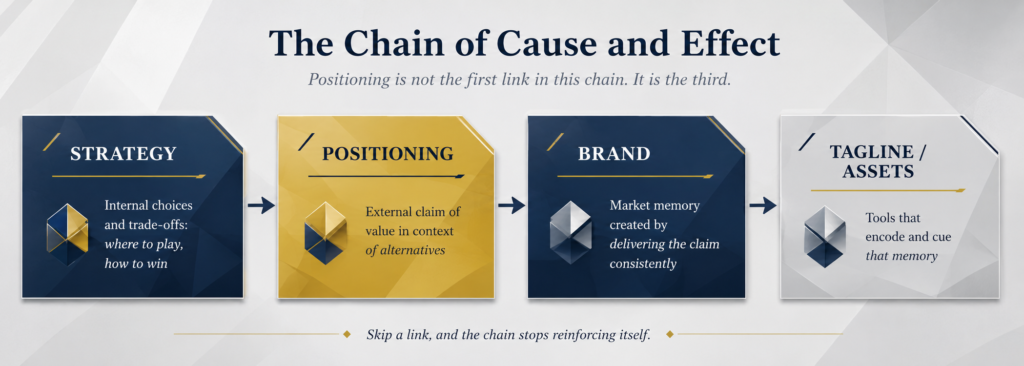
Strategy, positioning, and brand form a chain of cause and effect, and skipping a link breaks the whole system.
Strategy is the set of internal choices a company makes to win — where to play, how to win, what capabilities are required, and just as importantly, what the company will not do. Positioning is how those strategic choices show up externally, as a claim of value relative to alternatives. Brand is the market memory created by delivering on that claim consistently, over time.
Most positioning failures trace back to a structural problem: one group does strategy — or does planning and calls it strategy — while another group does positioning, usually marketing. Without deliberate alignment between the two, they don’t reinforce each other. They compete. And the customer feels the disconnect immediately, even if they can’t articulate why.
There are four recurring ways this system breaks down:
Generic positioning. The company claims to be “simpler,” “better,” or “premium” — benefits any competitor could claim with equal credibility. It doesn’t force a real choice at the moment of purchase. It’s just a nicer-sounding mousetrap.
Promises without proof. The message runs ahead of reality. The company positions on capabilities it doesn’t actually have yet, so the claim isn’t credible. Eventually the gap becomes visible, the positioning collapses, and trust takes the damage.
Differentiation that requires a TED Talk. If defending the claim takes a long explanation, the message is too complicated. Customers can’t repeat it, sales reps improvise, and the “position” becomes a different story every time it’s told.
Behavior that contradicts the promise. What the company says and what it does — customer experience, service standards, pricing practices, product quality — don’t match. When behavior and promise diverge, the market believes the behavior, not the slogan.
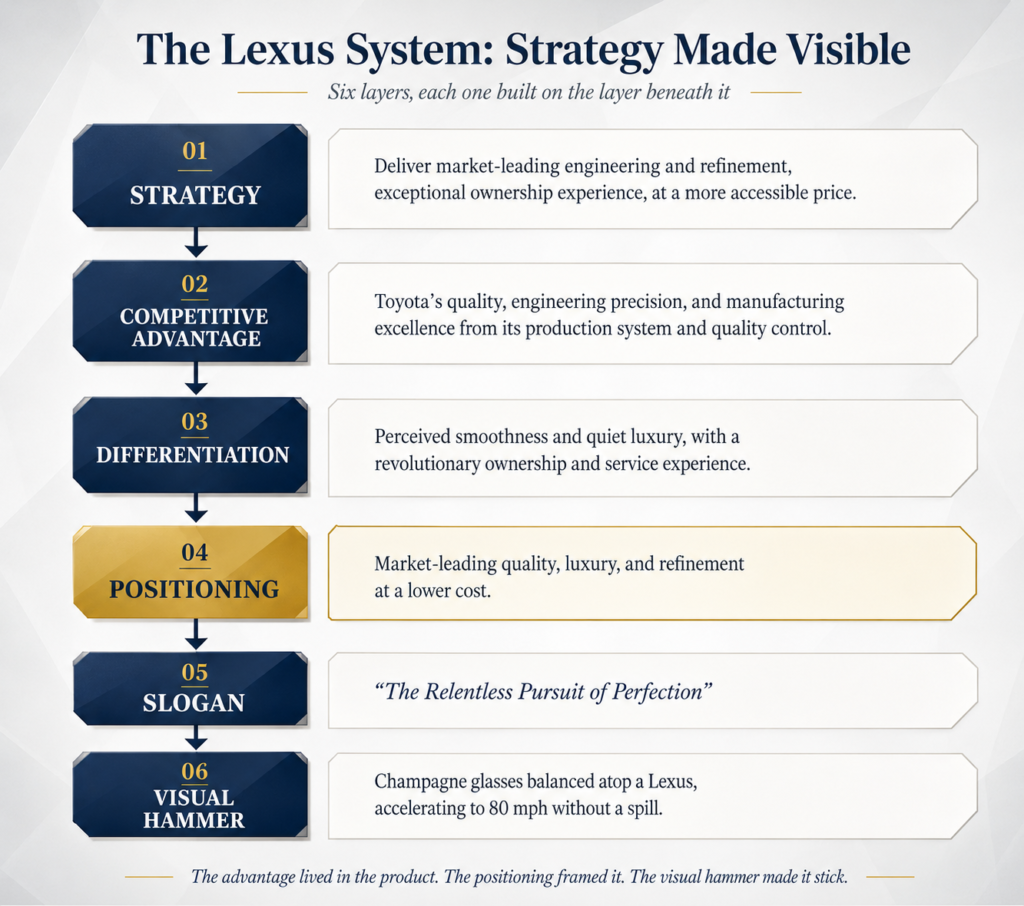
Lexus is a useful example of the system working as intended. Its strategy was to deliver market-leading engineering and refinement at a more accessible price than the established European luxury brands. That strategy was made possible by a real competitive advantage: Toyota’s manufacturing discipline, quality control, and engineering precision.
The differentiation customers actually experienced was smoothness, quiet, and a redefined ownership experience. The positioning that resulted — market-leading quality and refinement at a lower cost — was simply the honest external expression of everything happening underneath. The tagline, “The Relentless Pursuit of Perfection,” and the now-famous television ad of a champagne pyramid balanced on a car accelerating to 80 miles per hour, gave that positioning a memorable, visual proof point. The advantage lived in the product.
The differentiation showed up in how it felt to drive. The positioning framed it. The visual hammer made it stick. Strip away any one of those layers and the system stops working.
The Building Blocks of a Positioning Statement
Once strategy and differentiation are genuinely in place, positioning can be built on four elements.
Competitive frame. Every position exists relative to something. Before claiming a space, define the category and the alternatives customers actually compare you against — including indirect alternatives and the option of doing nothing. A position only means something in relation to what it’s positioned against. Good positioning also implicitly positions the competition; when a new bank positions itself as “a modern bank with modern services,” it is quietly framing established competitors as old banks with old services.
Target customer. A position cannot serve everyone equally well. It must be built for a specific, defined segment — grounded in that segment’s needs, priorities, and buying criteria, not in broad demographics. Trying to be equally compelling to every buyer is the fastest way to be compelling to none.
Value. The claim must connect to an outcome the target customer actually cares about — cost, risk, speed, status, reliability — not a generic superlative like “best-in-class” or “innovative.” Remove the superlatives from a positioning statement; if nothing meaningful remains, the position isn’t real yet.
Reasons to believe. A claim is only as strong as the proof behind it. Reasons to believe can include product capabilities, customer evidence, third-party validation, operational systems, or structural cost advantages — anything that makes the claim credible to a skeptical buyer rather than aspirational. Differentiation that can’t survive scrutiny isn’t differentiation; it’s a hypothesis.
A position built on these four elements, and grounded in a real strategic choice, tends to hold up under pressure. A position built only on clever language does not.
The Best Books and Resources on Positioning
For readers who want to go deeper into the discipline, the following books, articles, and video have shaped how positioning is understood and applied — and each is referenced in different ways throughout this book.
Best Positioning Books
- Positioning: The Battle for Your Mind, Al Ries and Jack Trout — the original, foundational text on the subject. Written in 1981, it remains the clearest explanation of how positions are won and lost inside the customer’s mind, and it is the book that put the discipline on the map.
- The 22 Immutable Laws of Branding, Al Ries and Laura Ries — a companion to the positioning canon, focused on how brands earn and defend a category over time, including the discipline required to resist brand extension and category dilution.
- Visual Hammer, Laura Ries — the definitive treatment of how a strong verbal position needs a visual counterpart to become memorable. Lexus’s champagne-glasses commercial, referenced earlier on this page, is a textbook example of the concept.
- Obviously Awesome, April Dunford — a practical, modern framework for building and testing a positioning statement, particularly useful for B2B and technology companies translating strategic choices into go-to-market language.
- Aaker on Branding, David Aaker — a rigorous look at how brand equity is built and measured over time, and a useful counterweight to positioning’s focus on a single, sharp idea.
- OutPosition: A Practitioner’s Guide to Competitive Strategy, Differentiation, and Market Leadership , Gerardo A. Dada — the book this page is drawn from, which argues that strategy, differentiation, and positioning are not separate disciplines but one reinforcing system, illustrated through cases including Apple, IBM, Ford, Lexus, Southwest Airlines, and a firsthand account of Rackspace’s strategic drift.
Top Positioning Articles
- “The Fundamentals of Effective Positioning” — a practitioner’s breakdown of eight rules for effective positioning, including why every strong position benefits from a clearly defined strategic enemy.
- “Creating a Category: How Catchpoint Repositioned Itself for Leadership” — a firsthand case study of repositioning a technology company from an undifferentiated “observability vendor” into the creator of a new category, Internet Performance Monitoring, and the strategic and organizational work that made the new position credible.
- “Establishing a Premium Position in the Market” — an earlier look at the psychological and emotional factors behind premium positioning, and why price, packaging, and employee experience all communicate value before a word of messaging is written.
Fundamentals of Positioning Video
Positioning, from the Product Marketing Course on YouTube — a short video lesson that walks through how positioning fits into the broader discipline of product marketing, aimed at practitioners translating strategy into a market-facing claim.
Conclusion
Positioning is often treated as the last step before a launch — the messaging layer applied once the “real” strategic work is done. Reframed correctly, it is not a finishing step at all. It is the visible test of whether the strategic work was done well in the first place. When strategy, differentiation, and positioning function as a single reinforcing system, the market notices — and it shows up in growth, in pricing power, and in the long-term difficulty competitors face trying to copy what looks, on the surface, deceptively simple.