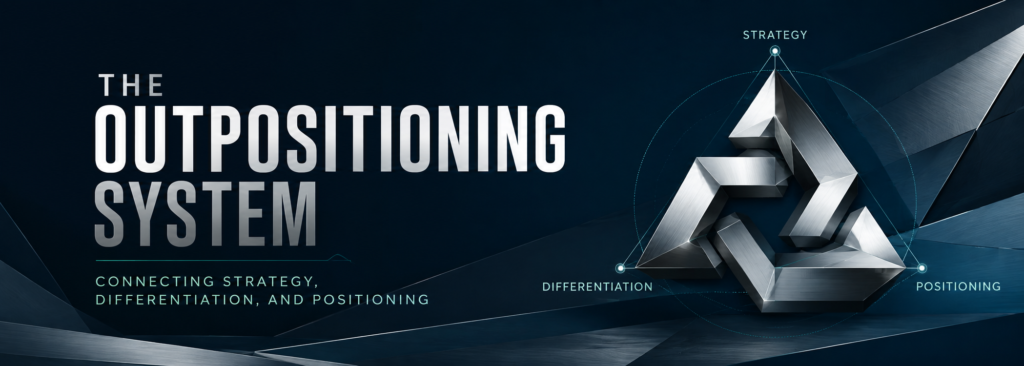
A practical framework for connecting strategy, differentiation, and positioning
What Is the OutPositioning System?
The OutPositioning System is a strategic framework that treats strategy, differentiation, and positioning not as three separate disciplines handled by three separate teams, but as one reinforcing system. It gives leaders a practical way to decide where to compete, build an advantage competitors cannot easily copy, and translate that advantage into a position customers understand and choose.
Most companies treat these three activities as sequential and disconnected: strategy sets direction, product and operations build differentiation, and marketing writes the positioning. Each function does its job reasonably well, and the result is still a company that sounds like everyone else. The OutPositioning System exists because that separation — not a lack of talent or effort in any one function — is usually the reason a sound strategy fails to produce a market advantage anyone notices.
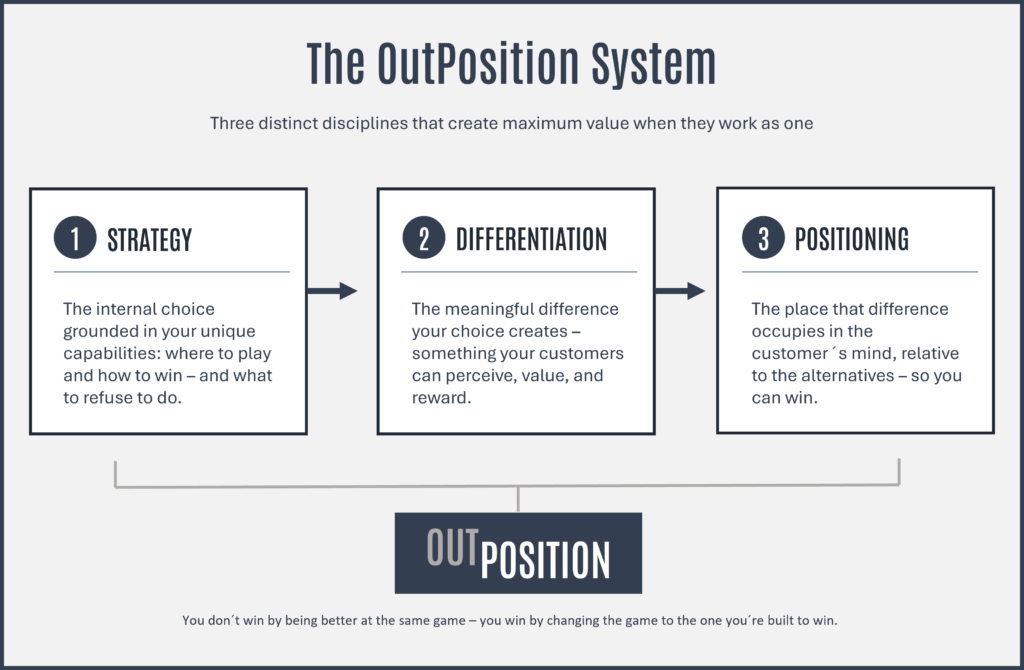
The OutPositioning System: Strategy → Differentiation → Positioning
Why Strategy, Differentiation, and Positioning Must Work Together
Each of these three disciplines can be done competently in isolation. None of them, on their own, is sufficient.
Strategy without differentiation produces a direction with no teeth — a company that has decided where to play but has nothing that makes it the right choice once it gets there. Differentiation without strategy produces a list of features and capabilities in search of a reason to exist, built because they were possible rather than because they served a chosen position. Positioning without real differentiation becomes messaging: language that claims a space in the customer’s mind the company has not actually earned in its value chain, and that collapses the first time a buyer looks closely.
Companies that win decisively tend to do something specific: they let their strategic choice determine what to build, they let what they build determine what they can credibly claim, and they let what they claim hold the whole system accountable. When one of the three moves without the other two, the system comes apart. This is not a new observation — Porter, Ries and Trout, and a long line of strategists before them each addressed a piece of it. OutPositioning is the practical connective tissue between what they described separately.
The Three Elements of the OutPositioning System
1. Strategy — Choose the Game You Want to Win
Strategy determines the game you choose to play.
Strategy defines where a company will compete and how it intends to win there. It answers who the customer is and, just as important, who is not the customer. It identifies the problem the company exists to solve and the markets, segments, and opportunities it will deliberately not pursue. Because strategy is a choice, it carries a cost — every market entered is a market not entered, every capability built is a capability not built elsewhere. A strategy that does not force the organization to give something up is not yet a strategy; it is a wish list.
2. Differentiation — Build an Advantage That Matters
Differentiation determines why you deserve to win.
Differentiation is the set of capabilities, product attributes, cost structures, business model choices, or customer experiences that make the strategy real and hard to replicate. It can live in the value chain, in proprietary technology, in a business model competitors cannot match without abandoning their own economics, or in an ecosystem that compounds over time. The test is not whether something is different — nearly everything can be made to sound different — but whether it is different in a way the target customer actually values enough to pay for, switch for, or stay for.
3. Positioning — Make the Advantage Clear
Positioning determines how the market understands why you should win.
Positioning is the deliberate claim a company makes on a specific space in the customer’s mind, relative to the alternatives available. It requires a defined competitive frame, a clear target customer, a stated value proposition, and credible reasons to believe the claim. Positioning is where strategy and differentiation become visible to the outside world — and where they are tested. A market will forgive an imperfect strategy longer than it will forgive a position the company cannot back up.
How OutPositioning Works
Applied as a process, the system moves through seven stages:
- Understand the market. Research customers, segments, competitors, and the trends reshaping the category — not to confirm existing assumptions, but to surface where real opportunity and real vulnerability sit.
- Choose where to play. Commit to a specific set of customers, needs, and arenas, and rule out the rest deliberately.
- Identify the basis of advantage. Determine which capability, asset, or system will make the chosen strategy defensible rather than aspirational.
- Build meaningful differentiation. Turn that basis of advantage into something customers experience directly — in the product, the service model, the economics, or the relationship.
- Define the competitive frame. Decide which alternatives the company will be judged against, since a position only exists relative to something else.
- Position around customer value. Translate the advantage into a claim the target customer finds relevant, credible, and easy to repeat in their own words.
- Reinforce the position through execution. Align systems, incentives, and day-to-day decisions so the position is delivered consistently, not just communicated once.
Strategy, Differentiation, and Positioning Reinforce One Another
The seven stages above read as a sequence, but the system is not meant to run once and stop. In practice, the three elements form a loop, and each one continually tests the other two.
Weak positioning often reveals weak differentiation before anything else does — a claim that will not survive a skeptical buyer’s questions usually means the underlying advantage was never as strong as assumed. Building real differentiation frequently forces a strategic choice the company was avoiding, such as leaving a segment it cannot serve as well as another. And a shift in strategy — entering a new market, responding to a new competitor, adjusting to a changed environment — almost always requires a new position, because the old claim no longer matches the new game.
Companies that treat strategy, differentiation, and positioning as a one-time planning exercise tend to drift, because markets do not hold still. Companies that treat the three as a live, reinforcing system are able to adjust one element without losing coherence across the other two.
How OutPositioning Differs From Traditional Positioning
| Traditional positioning | OutPositioning |
|---|---|
| Primarily a marketing exercise | A company-wide strategic discipline |
| Starts with messaging | Starts with strategic choices |
| Focuses on perception | Connects perception to real advantage |
| Often owned by marketing alone | Requires product, strategy, sales, and leadership together |
| Describes differentiation | Helps create differentiation |
Traditional positioning work is frequently asked to do something it was never built for: make an underlying strategy sound compelling after the fact. OutPositioning starts earlier, at the strategic choice itself, so the position that eventually reaches the market is a description of a real advantage rather than a substitute for one.
How the OutPositioning System Relates to Other Strategy Frameworks
Michael Porter’s work on competitive positioning and the value chain, Roger Martin’s Playing to Win, Kim and Mauborgne’s Blue Ocean Strategy, Al Ries and Jack Trout’s foundational work on positioning, April Dunford’s Obviously Awesome, jobs-to-be-done theory, and category design each address a real and important part of the strategic problem.
These frameworks are not competitors to the OutPositioning System — they are its raw material. Porter explains how a value chain produces a defensible position. Ries and Trout explain how a position is won in the customer’s mind. Playing to Win offers a disciplined language for the strategic choice itself. Each is powerful within its own domain, and each tends to be used in isolation, by a different function, at a different stage of the process.
The OutPositioning System is designed to connect these established ideas into a practical sequence — from strategic choice, to competitive advantage, to market perception — so that a company’s strategy team, product organization, and marketing function are working from the same coherent framework rather than three independent ones.
An Example of OutPositioning
Lexus offers a clean illustration of how the three elements work as one system.
Strategy. Lexus chose to compete in the U.S. mid-to-high luxury sedan market, targeting buyers considering Mercedes-Benz and BMW who valued comfort, refinement, and reliability over outright sportiness.
Differentiation. The advantage was built on Toyota’s manufacturing discipline — engineering precision and quality control that produced a genuinely quieter, more reliable car — combined with a reinvented dealership experience: white-glove service, loaner vehicles, and an obsessive focus on customer satisfaction that no established luxury competitor matched at the time.
Positioning. Lexus claimed the position of market-leading quality and refinement at a lower cost than the German incumbents, expressed through the slogan “The Relentless Pursuit of Perfection” and made vivid through a single piece of proof: a television ad showing a stack of full champagne glasses balanced on the hood of a Lexus as it accelerated to eighty miles an hour without spilling a drop.
The strategy defined the arena. The differentiation made the claim true. The positioning made it memorable. When Lexus later drifted from this system — pursuing a sports-luxury repositioning the brand had not earned and adopting the vague slogan “Experience Amazing” — the position lost its edge, because it was no longer connected to a differentiation the company could actually deliver.
Common OutPositioning Mistakes
The same failure patterns recur across industries. Companies start with messaging instead of strategy, writing a compelling position before deciding what advantage it is meant to describe. They try to differentiate on too many dimensions at once, diluting the brand until it stands for nothing in particular. They confuse uniqueness with value, building something genuinely different that the target customer does not actually care about. They copy a competitor’s positioning language while lacking the underlying differentiation to support it. They treat positioning as a slogan exercise rather than a claim that must be proven daily. They choose a market that undermines the very advantage they are trying to build. And they fail to align product, sales, and operations with the position, so the market experiences a gap between what was promised and what was delivered.
Each of these is, in practice, a break in the loop — a place where one of the three elements moved without the other two.
When Should a Company Use the OutPositioning System?
The framework is most useful at moments of real strategic consequence: entering a new market, launching a new product, facing commoditization in a category that once rewarded differentiation, repositioning a company whose original advantage has eroded, losing ground to a competitor with a sharper claim, moving upmarket, attempting to create a new category, integrating an acquisition without diluting focus, or rebuilding growth after a period of stagnation. In each case, the underlying problem is the same: strategy, differentiation, and positioning have fallen out of alignment, and reconnecting them is the fastest path back to a defensible market advantage.
Who Is the OutPositioning System For?
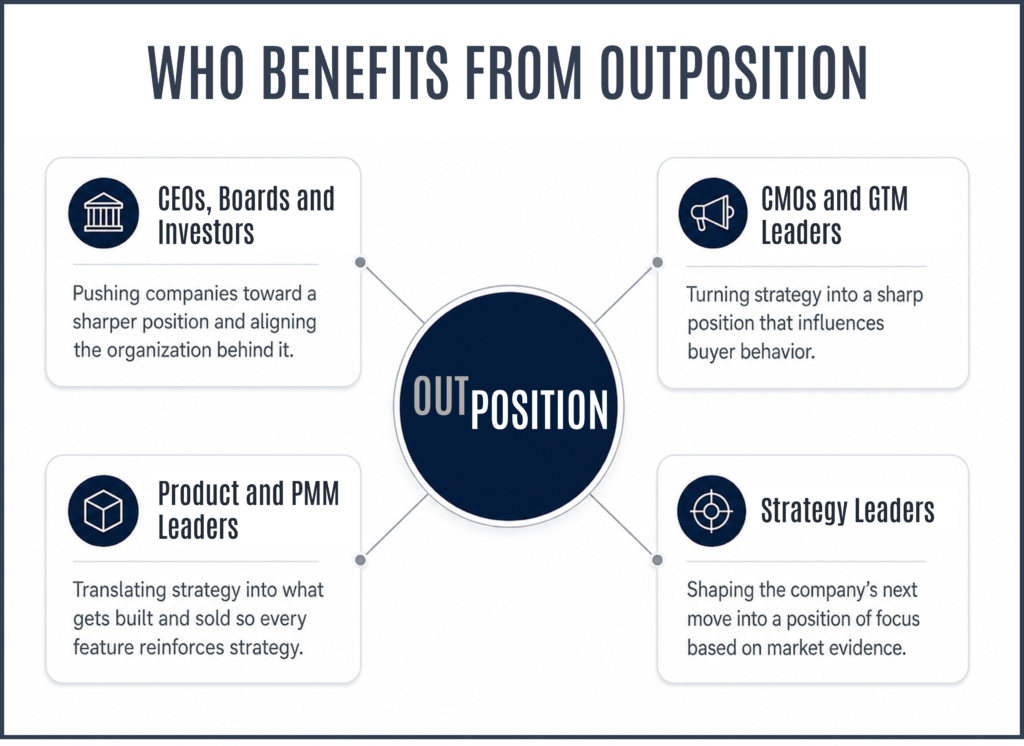
The framework is built for the people who own the consequences of these decisions: CEOs setting direction for the enterprise, CMOs and product marketing leaders responsible for how the company shows up in the market, chief product officers and product leaders who build the differentiation the position depends on, strategy teams tasked with the underlying choices, founders defining a company from its first customer, and investors or operating partners evaluating whether a portfolio company’s strategy, differentiation, and positioning actually reinforce one another.
Frequently Asked Questions
What is OutPositioning? OutPositioning is a strategic framework that connects strategy, differentiation, and positioning into one reinforcing system, rather than treating them as separate exercises owned by separate teams. It helps a company choose where to compete, build an advantage that matters, and make that advantage clear to the market.
Download the What is OutPositioning PDF below
What is the difference between positioning and OutPositioning? Positioning is one of the three elements within the OutPositioning System — the discipline of making a company’s advantage clear to the customer. OutPositioning is the larger system that connects positioning to the strategic choice and the differentiation that make the position credible in the first place.
Is OutPositioning a strategy framework? It is a framework that spans strategy, differentiation, and positioning together. It draws on strategic frameworks such as Porter’s work and Playing to Win, but its specific purpose is connecting strategic choice to market perception through a defensible advantage.
What is the relationship between strategy and positioning? Strategy defines where a company competes and how it intends to win. Positioning is how that choice becomes visible and credible to customers. Positioning without a clear underlying strategy tends to become messaging that cannot be sustained under scrutiny.
What is the difference between differentiation and positioning? Differentiation is the real, structural advantage a company builds — in its product, cost structure, or value chain. Positioning is the claim the company makes about that advantage in the customer’s mind. Differentiation must exist before positioning can be credible.
Can a company have strong positioning without differentiation? Only briefly. A position not backed by real differentiation may work in initial messaging, but it collapses under competitive scrutiny or customer experience, because there is no underlying advantage to sustain the claim over time.
How does OutPositioning relate to competitive advantage? Competitive advantage is the internal, structural source of a company’s edge — the capability or asset a competitor cannot easily replicate. OutPositioning treats competitive advantage as the link between the strategic choice and the external claim the company makes through positioning.
How is OutPositioning different from category creation? Category creation is one possible outcome of strong positioning — establishing an entirely new frame of reference rather than competing within an existing one. OutPositioning is the broader system a company uses to reach that outcome, whether it results in category creation or a strong position within an existing category.
Who created the OutPositioning System? The OutPositioning System was developed by Gerardo A. Dada, a technology marketing and strategy executive, and is presented in full in his book, OutPosition.
Where can I learn more about the framework? The complete system — including the underlying frameworks, extended case studies, and implementation guidance — is developed in OutPosition: A Practitioner’s Guide to Achieving Market Dominance Through Strategy, Differentiation, and Positioning Mastery.
The OutPositioning System Is Described in OutPosition
OutPosition: A Practitioner’s Guide to Achieving Market Dominance Through Strategy, Differentiation, and Positioning Mastery Gerardo A. Dada
This page introduces the OutPositioning System at a high level. The book develops the complete framework in depth — the tools for each stage, extended case studies including Apple, IBM, Ford, T-Mobile, Southwest Airlines, and a candid firsthand account of strategic drift at Rackspace, and a practical process for applying the system inside a real organization.

About Gerardo A. Dada
Gerardo A. Dada is a B2B technology marketing and strategy executive with more than thirty years of experience, including CMO and senior leadership roles at Microsoft, Rackspace, SolarWinds, Bazaarvoice, and Catchpoint. He has led strategy, differentiation, and positioning work across companies ranging from early-stage startups to global technology leaders. He writes at TheAdaptiveMarketer.com and is the author of OutPosition, the book that develops the OutPositioning System in full.
Related OutPosition Resources
- OutPosition: A Strategy Book on Positioning & Differentiation
- Reviews – OutPosition Book
- Strategy Differentiation Positioning – OutPosition Book
- Buy the Book OutPosition on Amazon
- The Adaptive Marketer – Marketing Strategy and Leadership Posts by Gerardo A. Dada