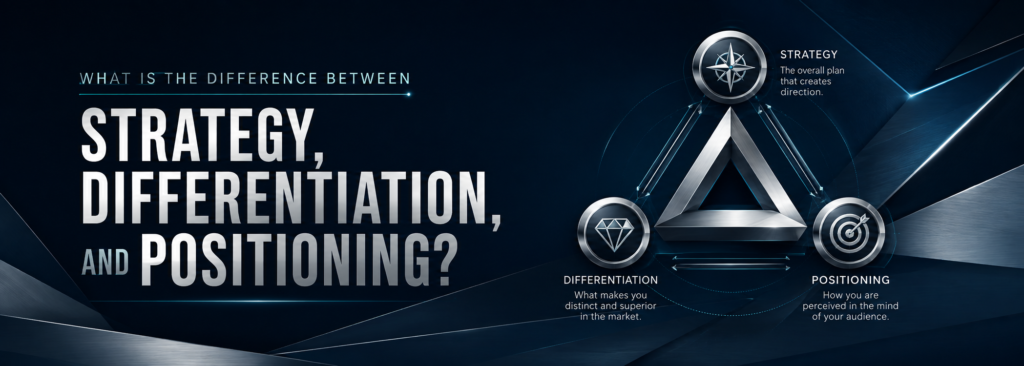
Strategy, differentiation, and positioning are three distinct disciplines that most companies treat as interchangeable — and that confusion is one of the more expensive mistakes in business. Strategy is the choice of where to compete and how to win. Differentiation is the real advantage that makes that choice defensible. Positioning is the claim the company makes to the market so customers understand why that advantage matters to them. Each depends on the other two. None of them, alone, produces a lasting result.
What Is Strategy?
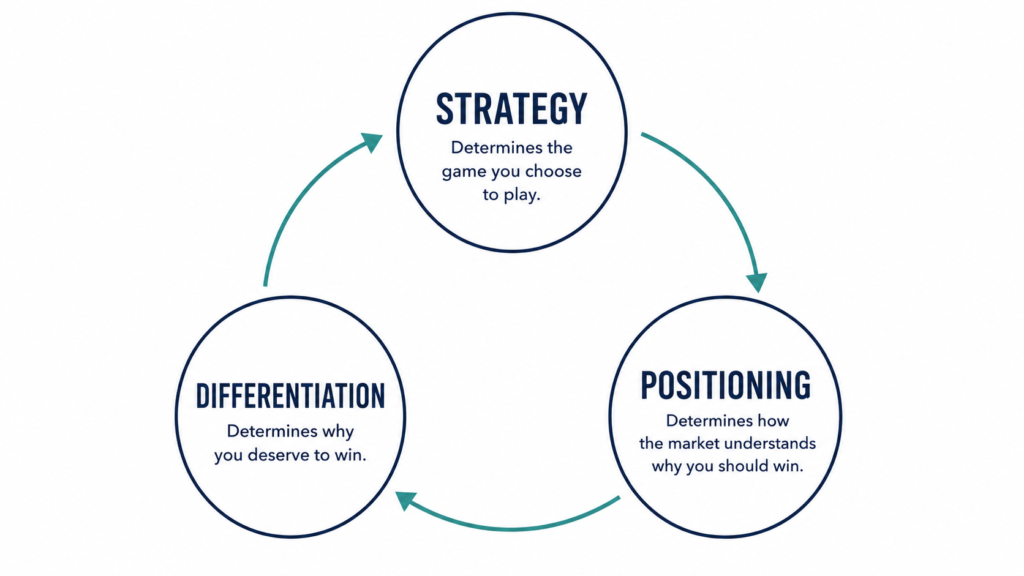
Strategy determines the game you choose to play.
Strategy is the deliberate choice an organization makes about where it will compete and how it will win. It defines the customers a company will serve, the markets it will pursue, and — just as important — the customers and markets it will not. Strategy is not a goal, a mission, or a list of initiatives. A goal describes a desired outcome; strategy explains the logic for achieving it.
Because strategy is a choice, it carries a cost. Every market a company decides to serve is a market it has implicitly decided not to prioritize. A.J. Lafley, former CEO of Procter & Gamble, put it simply: strategy is where to play and how to win. Both halves of that definition require the organization to say no to something, which is precisely why strategy is harder to commit to than it is to describe.
A company without a clear strategy tends to compensate with activity — more products, more markets, more initiatives — without any of it adding up to an advantage anyone can name.
What Is Differentiation?
Differentiation determines why you deserve to win.
Differentiation is the meaningful difference a company builds relative to its alternatives — the reason a customer should choose it instead of a competitor. It shows up in a product’s capabilities, a company’s cost structure, its business model, its customer experience, or the way its value chain is configured. Differentiation is not the same as being different for its own sake. A feature no customer values is not differentiation; it is noise.
Differentiation has both an external and an internal dimension. Externally, it is what the customer perceives and experiences. Internally, it is the capability, asset, or system that makes that experience possible and hard for a competitor to copy. A company can claim differentiation it does not actually have, but that gap surfaces quickly — in churn, in lost deals, or in a sales team that cannot answer a skeptical buyer’s questions with a straight face.
Durable differentiation is rarely a single feature. It is usually a system of reinforcing choices in the value chain that a competitor would need to rebuild its entire operating model to replicate.
What Is Positioning?
Positioning determines how the market understands why you should win.
Positioning is the deliberate effort to occupy a specific, valuable space in the customer’s mind, relative to the alternatives available. It is not the product itself — it is what the product means to the customer. Positioning requires a defined competitive frame, a clearly identified target customer, a value proposition, and credible reasons the customer should believe the claim.
Positioning is where strategy and differentiation become visible to the outside world. A brand occupies a single position at a time — attempts to own several attributes at once tend to dilute the position until the brand stands for nothing distinct. This is why the sharpest positioning statements are often narrow by design: BMW does not claim comfort, safety, efficiency, and driving pleasure equally. It claims one thing — “the ultimate driving machine” — and lets everything else be a hygienic expectation rather than the reason to buy.
Why Companies Confuse Them
The confusion is understandable, because all three disciplines eventually produce language, and language is where most people first encounter them. A one-line strategy statement, a differentiation claim, and a positioning statement can look nearly identical on a slide, even though they are answering three different questions.
The confusion is also organizational. Strategy is typically owned by the executive team, differentiation is built by product and operations, and positioning is written by marketing. Each function does its part reasonably well in isolation, and each hands off to the next assuming the earlier work was solid. When positioning is written without a clear strategic choice behind it, it becomes marketing copy that sounds good and means little. When differentiation is built without a strategy to guide it, the company accumulates features that do not add up to an advantage. When strategy is set without an honest view of what the organization can actually build and credibly claim, it becomes an aspiration rather than a plan.
The result, in most organizations, is not that any one discipline is done badly — it is that the three are never explicitly connected, so the company cannot tell whether its position is actually earned or simply asserted.
How Strategy, Differentiation, and Positioning Work Together
The three disciplines form a chain of cause and effect, and each one constrains the next.
Strategy defines the arena and the basis on which the company intends to compete. Differentiation is what makes that intention real — the capabilities and systems built specifically to deliver on the strategic choice. Positioning is the claim the company makes about that differentiation, expressed in terms the target customer finds relevant and credible.
The relationship also runs in reverse, which is where most companies stop paying attention. A position that customers do not believe usually points to differentiation that is not as strong as assumed. Differentiation that turns out to be difficult to build often points back to a strategic choice that needs to be reconsidered. Treated only as a one-time sequence — strategy first, then differentiation, then positioning, done — the system goes stale the moment the market shifts. Treated as a loop that gets revisited as conditions change, it stays coherent over time.
A Simple Example
Southwest Airlines illustrates how the three elements connect.
Strategy. Southwest chose to compete on low-cost, efficient, point-to-point air travel, targeting price-sensitive travelers who did not need first-class seating, assigned seats, or meals — and explicitly accepted giving up the customers who did.
Differentiation. The strategy was made real through a specific set of operating choices: a single aircraft model, which simplified maintenance and crew training; no assigned seating, which sped up boarding and turnaround times; and a point-to-point route network instead of a hub-and-spoke system, which reduced delays and cost. None of these choices were incidental — each one reinforced the others and made the low-cost model structurally difficult for a legacy carrier to copy without rebuilding its entire operation.
Positioning. Southwest claimed the position of the airline that gets you there on time, at the lowest fare, while making the experience genuinely enjoyable — a claim the company could back up because the underlying differentiation actually produced lower costs and faster turnarounds. When a customer once complained to CEO Herb Kelleher about the lack of first-class seating, his answer captured the whole system in three words: “We will miss you.” That is a company whose strategy, differentiation, and positioning are in complete alignment.
How the OutPositioning System Connects All Three
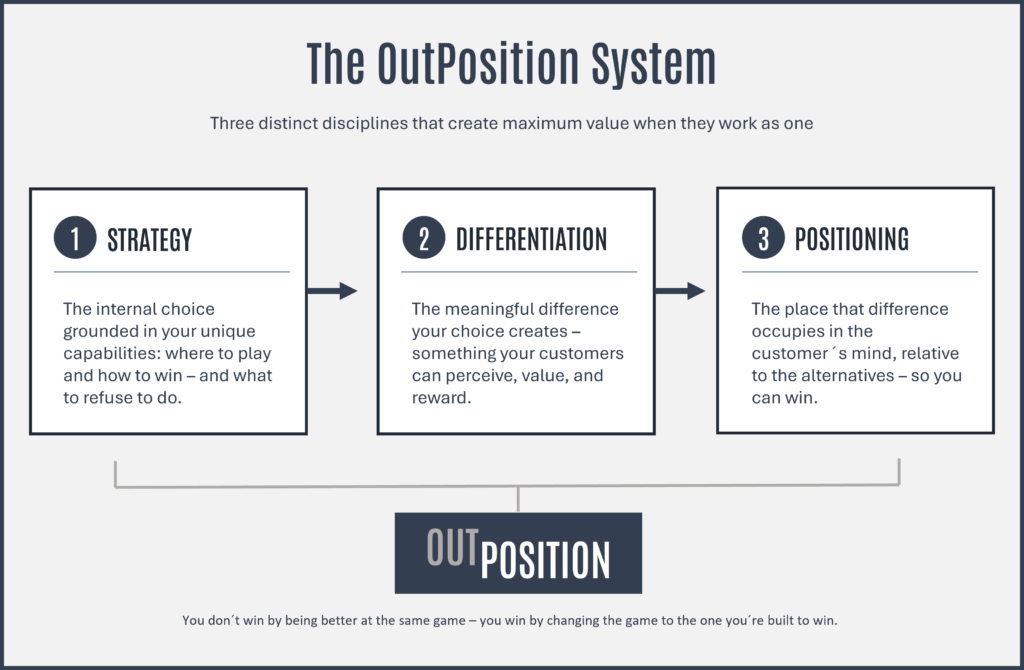
Most strategy and marketing frameworks address one of these three disciplines well and leave the connections between them implicit. Porter’s work explains how a value chain produces a defensible position. Ries and Trout explain how a position is won in the customer’s mind. Fewer frameworks explain how a company gets from a strategic choice, through a real and defensible advantage, to a market claim customers actually believe — and how to keep those three elements aligned as the market changes.
That is the specific purpose of the OutPositioning System: a practical framework that treats strategy, differentiation, and positioning as one reinforcing system rather than three separate exercises owned by three separate teams. It gives leaders a disciplined way to move from where to compete, to why they deserve to win there, to how the market understands that advantage — and to keep revisiting the loop as strategy, competitors, and customer needs evolve.
The full system, including the process for applying it and extended case studies, is detailed on the OutPositioning System page and developed completely in OutPosition.
Frequently Asked Questions
What is the difference between strategy and positioning? Strategy is the internal choice of where to compete and how to win. Positioning is the external claim a company makes to customers about why its advantage matters to them. Strategy comes first; positioning without a strategic choice behind it becomes messaging with no foundation.
What is the difference between differentiation and positioning? Differentiation is the real, structural advantage a company builds — in its product, cost structure, or value chain. Positioning is the claim the company makes about that advantage in the customer’s mind. Differentiation must exist before positioning can be credible; otherwise the claim will not survive scrutiny.
Is positioning part of marketing or strategy? Positioning is often assigned to marketing, but it cannot succeed as a marketing-only exercise. A credible position depends on a strategic choice and a real differentiation built elsewhere in the organization — product, operations, and leadership all have a stake in whether the position is true.
Can two companies have the same strategy but different positioning? Yes. Two airlines could both pursue a low-cost strategy and still position themselves differently — one around reliability, another around a distinctive customer experience — depending on how each has chosen to differentiate and which claim it can credibly back up.
What comes first, differentiation or positioning? Differentiation comes first. Positioning describes an advantage that already exists, or that the company is actively building. Positioning ahead of real differentiation is a common cause of strategies that sound compelling and then fail to hold up once customers experience the product.
How do strategy, differentiation, and positioning relate to competitive advantage? Competitive advantage is the underlying capability or asset that makes differentiation possible and hard to copy. Strategy decides where that advantage will be built and applied; positioning is how the market comes to understand it.
Why do so many companies get this wrong? Because strategy, differentiation, and positioning are usually owned by different functions — leadership, product, and marketing — who rarely treat the three as a single connected system. Each piece can be done well in isolation and still fail to add up to a coherent market advantage.
Related OutPosition Resources
- OutPosition: A Strategy Book on Positioning & Differentiation
- Reviews – OutPosition Book
- OutPositioning System – OutPosition Book
- Buy the Book OutPosition on Amazon
- The Adaptive Marketer – Marketing Strategy and Leadership Posts by Gerardo A. Dada